
How to Read a WGU Course of Study Before You Start Studying
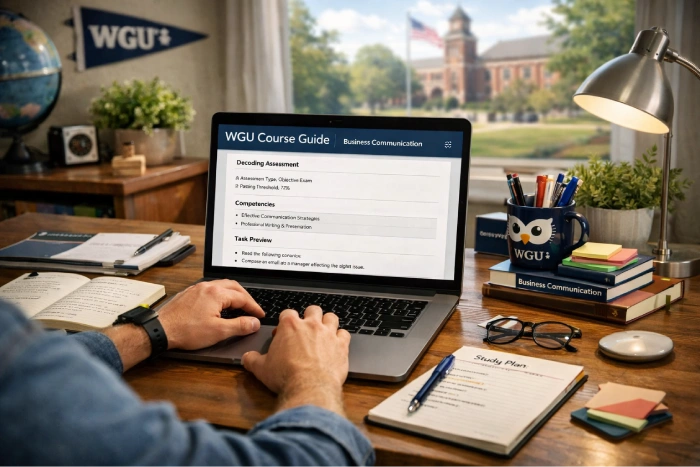
A WGU Course of Study is not a typical syllabus; it contains the information you need to demonstrate, including competencies, resources, and assessment information. The most effective way to do this is to start at the end – knowledge gaps given in the competencies and the type of assessment – then use the learning resources to fill in the gaps. This way, you won’t waste hours examining content just because it’s listed first.
What a WGU Course of Study Actually Contains
A WGU Course of Study provides you with details about a course that will allow you to learn about the course content and how your competency will be evaluated. Don’t think of it as a syllabus with weeks assigned like you would in a classroom. Instead, think of it as a course roadmap, not a week-by-week syllabus.
Typically, there are 4 key sections to be found:
- Competencies: Skills/Knowledge expected to be exhibited.
- Learning resources: Reading, videos, guides and other resources that support the learning.
- Learning community information: Discussions about the course and opportunities for peer support.
- Assessment information: Description of the type of assessment (Objective Assessment (OA) or Performance Assessment (PA) for the course.
The competency list is where you’re going! Learning materials are a means to an end, so you don’t have to follow all learning materials sequentially.
Why You Should Read It Backwards (Competencies First, Not the First Resource)
A best practice for reading a WGU Course of Study is to begin with the competencies, as these will tell you what you will be expected to show at the end of the course. Unlike a syllabus, with a traditional approach, students would typically start with the first chapter and proceed.
Ask: Can I explain/demonstrate this right now without studying it? (For each competency)
Next, categorise each competency as being in one of three categories:
- Confident: You can either describe or use it with confidence.
- Confused: You know it, but you need more practice.
- Unfamiliar: The idea is novel or doesn’t make sense to you.
This quick and easy comparison will help you understand where you should spend your study time. It also allows you to distinguish which of the subjects are crucial and which are not before a test from WGU should be taken and how to identify the most important topics before a WGU exam.
Step-by-Step: Turn Your Course of Study into a Task List
Take the same five steps to make a course plan for a new WGU course.
Select Course of Study First
Find the Course of Study in your course materials and read through it before starting any learning activity. You should first get a grasp of the structure of the course, and not begin memorising information.
Specifically check for the competency list and assessment information. The rest of the course will be approached based on the two areas.
Rate Every Competency
For each competency, mark confident, unsure or unfamiliar with the competency. Be honest; don’t assume anything is unknown. What you already know can be a good starting point and will help you figure out where you need to study.
Assessment Type
Then Identify your Course Type (Objective Assessment or Performance Assessment). The mode of assessment has an impact on the way you are to prepare. Typically, for an OA, preparation consists of active recall, practice questions and using concepts in exam-like settings. Passing WGU objective assessments on the first attempt is a step-by-step process that can be accomplished with this objective assessment study guide.
Set up a study plan
Once you know what your weaker competencies are, you can start to review resources for learning. Choose readings, videos or other information that directly focuses on the areas you identified as being unsure or unknown. The reverse-reading method is centred on this. Rather than asking, “What resource is next?” ask, “Which resource will help me improve this competency?
Write a short list of daily tasks
Convert the insights into a concise list of studies instead of a massive study plan. Consider using 3-5 resources or actions related to your lowest skills.
Some items that could be added to your list are:
- Rereading a text for information on an unknown idea
- Viewing a video that helps to explain something hard to understand
- Completing practice questions
- Re-checking a competency upon completion of study/experience
- Assigning competency readiness or as an ongoing competency
This will provide a study process that is based on one’s actual needs, NOT the order of the resources
Objective Assessment vs. Performance Assessment: Why the Course of Study Tells You Which One You’re Facing
An assessment type will indicate to you how you are going to demonstrate competency – so you need to know this first before planning for it.
Objective Assessments (OAs) are typically timed and proctored exams which require knowledge and skill application. The key to your preparation is to rehearse, practise questions and recall what topics you have often missed in the past. For additional tips, see the step-by-step guide to passing your first WGU objective assessment.
Performance Assessments (PAs) are written or project-based and have requirements and rubrics. The preparation should include: understanding the task, communicating the task requirements, and developing work showing the required competencies. For more detail, please refer to the WGU performance assessments explained.
If you know what the assessment is, you won’t adopt a preparatory method that is inappropriate.
Common Mistakes Students Make When Skipping This Step
Often, students will need to do the Course of Study review, but they will consider all the resources equally important to their learning, which is an unnecessary task.
Common mistakes include:
- Topic: Starting with the first learning resource
- Delays the assessment of competencies until later
- HOURS spent reading topics that you are already familiar with
- The participation of students who were not identified as the type of assessment
- The way RA, OA and PA were prepared was the same
- Students will be assessed on competencies during the assessment week
The Course of Study provides a planning tool, not just a book to read and will not have these problems.
A Simple Checklist to Run at the Start of Every New Course
Follow this quick checklist before studying any new WGU course:
- Open up the Course of Study first.
- Read through all of the competencies and rate them.
- Identify if the assessment is an OA or PA.
- Use resources to help fill in areas of weakness.
- Go over the competency list one last time before assessment day.
This only takes a few minutes, but can save hours of wasted study time.
FAQ
Q: What is a WGU Course of Study?
A WGU Course of Study is a document that summarises course competencies, learning resources, assessment information, and information about the learning community students will use to plan their learning effectively (this is equivalent to a syllabus).
Q: Where do I find my WGU Course of Study document?
Your Course of Study for your WGU course is available in your course materials, typically in the student portal. If it’s not there, then look on your course page or see your Program Mentor.
Q: What’s the difference between a Course of Study and a Course Description?
A Course Description provides a brief overview of the content of a course, while a Course of Study offers detailed competencies, learning resources, assessment information and other guidance for the completion of specific requirements.
Q: Should I read every learning resource in a Course of Study?
No, it isn’t necessary to have all of the resources. Identify the weak competencies, and choose readings, videos, and activities that directly address these specific gaps in knowledge or competencies.
Q: How does the Course of Study tell me whether I’ll take an OA or a PA?
The assessment information indicates if your course is an Objective Assessment or Performance Assessment. This awareness will help you to select preparation techniques that match your assessment type and needs.
Closing CTA Guidance
Reading a WGU Course of Study can help you get much more targeted in your study process. Begin with the competencies, determine what you don’t know, make sure it’s the right type of assessment, and then choose the resources you need to learn what you don’t know.
Decoding a document can save a lot of time in unnecessary studying, as it takes only a few minutes. Consider WGU exam tutoring services or contact OnlineWGUExamHelp for customised assistance in recognising weak competencies or preparing for an upcoming examination.